

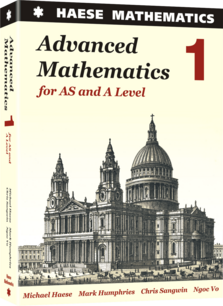
About the Book
Year Published: 2017
Page Count: 660
ISBN: 978-1-925489-30-9 (9781925489309)
Online ISBN: 978-1-925489-31-6 (9781925489316)

Year Published: 2017
Page Count: 660
ISBN: 978-1-925489-30-9 (9781925489309)
Online ISBN: 978-1-925489-31-6 (9781925489316)
| SYMBOLS AND NOTATION USED IN THIS BOOK | 10 | ||
| 1 | LINES | 13 | |
| A | Linear equations | 14 | |
| B | Equations of straight lines | 17 | |
| C | Points on lines | 21 | |
| D | Graphing lines | 22 | |
| E | Linear relationships | 25 | |
| F | Simultaneous linear equations | 28 | |
| Review set 1A | 34 | ||
| Review set 1B | 35 | ||
| 2 | RECIPROCAL RELATIONSHIPS | 37 | |
| A | Inverse proportion | 38 | |
| B | Reciprocal functions | 41 | |
| C | Equations involving reciprocals | 44 | |
| Review set 2A | 45 | ||
| Review set 2B | 45 | ||
| 3 | QUADRATICS | 47 | |
| A | Quadratic equations | 49 | |
| B | The discriminant of a quadratic | 55 | |
| C | The sum and product of the roots | 57 | |
| D | Quadratic functions | 59 | |
| E | Finding a quadratic from its graph | 69 | |
| F | Simultaneous equations | 73 | |
| G | Problem solving with quadratics | 75 | |
| H | Quadratic optimisation | 78 | |
| Review set 3A | 80 | ||
| Review set 3B | 81 | ||
| 4 | RELATIONS AND FUNCTIONS | 83 | |
| A | Relations and functions | 84 | |
| B | Function notation | 87 | |
| C | Domain and range | 90 | |
| D | Transformations | 96 | |
| E | Rational functions | 107 | |
| Review set 4A | 110 | ||
| Review set 4B | 112 | ||
| 5 | INEQUALITIES | 115 | |
| A | Linear inequalities | 117 | |
| B | Sign diagrams | 122 | |
| C | Quadratic inequalities | 125 | |
| D | Rational inequalities (Extension) | 127 | |
| Review set 5A | 128 | ||
| Review set 5B | 129 | ||
| 6 | SURDS, INDICES, AND EXPONENTIALS | 131 | |
| A | Surds | 132 | |
| B | Indices | 136 | |
| C | Index laws | 138 | |
| D | Rational indices | 141 | |
| E | Algebraic expansion and factorisation | 143 | |
| F | Exponential equations | 145 | |
| G | Exponential functions | 147 | |
| H | Growth and decay | 151 | |
| I | The natural exponential $e^x$ | 156 | |
| Review set 6A | 159 | ||
| Review set 6B | 161 | ||
| 7 | LOGARITHMS | 163 | |
| A | Logarithms in base 10 | 164 | |
| B | Logarithms in base $a$ | 167 | |
| C | Laws of logarithms | 169 | |
| D | Natural logarithms | 171 | |
| E | Solving exponential equations using logarithms | 175 | |
| F | Growth and decay | 176 | |
| G | Logarithmic functions | 178 | |
| Review set 7A | 184 | ||
| Review set 7B | 186 | ||
| 8 | REAL POLYNOMIALS | 187 | |
| A | Polynomials | 188 | |
| B | Operations with polynomials | 189 | |
| C | Zeros, roots, and factors | 193 | |
| D | Polynomial equality | 196 | |
| E | Polynomial division | 199 | |
| F | The Remainder theorem | 202 | |
| G | The Factor theorem | 204 | |
| H | Sum and product of roots theorem | 205 | |
| I | Graphing cubic functions | 207 | |
| J | Graphing quartic functions | 213 | |
| K | Polynomial equations | 218 | |
| Review set 8A | 219 | ||
| Review set 8B | 221 | ||
| 9 | THE BINOMIAL THEOREM | 223 | |
| A | Factorial notation | 224 | |
| B | Counting | 226 | |
| C | Binomial expansions | 229 | |
| D | The binomial theorem | 231 | |
| Review set 9A | 235 | ||
| Review set 9B | 236 | ||
| 10 | CIRCLES | 237 | |
| A | The equation of a circle | 238 | |
| B | Tangents and chords | 244 | |
| Review set 10A | 247 | ||
| Review set 10B | 247 | ||
| 11 | TRIGONOMETRY | 249 | |
| A | The unit circle | 250 | |
| B | The multiples of 30° and 45° | 254 | |
| C | Finding trigonometric ratios | 256 | |
| D | Finding angles | 258 | |
| E | The area of a triangle | 260 | |
| F | The cosine rule | 263 | |
| G | The sine rule | 266 | |
| H | Problem solving | 271 | |
| Review set 11A | 277 | ||
| Review set 11B | 278 | ||
| 12 | TRIGONOMETRIC FUNCTIONS | 281 | |
| A | Periodic behaviour | 282 | |
| B | The sine and cosine functions | 285 | |
| C | Problem solving with trigonometric functions | 290 | |
| D | The tangent function | 292 | |
| E | Trigonometric equations | 294 | |
| Review set 12A | 296 | ||
| Review set 12B | 298 | ||
| 13 | REASONING AND PROOF | 299 | |
| A | Logical connectives | 301 | |
| B | Proof by deduction | 303 | |
| C | Proof by equivalence | 305 | |
| D | Definitions | 308 | |
| E | Proof by exhaustion | 310 | |
| F | Disproof by counter example | 311 | |
| Review set 13A | 312 | ||
| Review set 13B | 312 | ||
| 14 | INTRODUCTION TO DIFFERENTIAL CALCULUS | 313 | |
| A | Rates of change | 315 | |
| B | Instantaneous rates of change | 318 | |
| C | Finding the gradient of the tangent | 320 | |
| D | The derivative function | 324 | |
| Review set 14A | 329 | ||
| Review set 14B | 331 | ||
| 15 | DERIVATIVES AND THEIR APPLICATIONS | 333 | |
| A | Simples rules of differentiation | 334 | |
| B | Second derivatives | 339 | |
| C | Tangents and normals | 340 | |
| D | Increasing and decreasing functions | 344 | |
| E | Stationary points | 348 | |
| F | Shape | 352 | |
| G | Optimisation | 354 | |
| Review set 15A | 358 | ||
| Review set 15B | 359 | ||
| 16 | INTEGRATION | 361 | |
| A | The area under a curve | 362 | |
| B | Antidifferentiation | 368 | |
| C | The Fundamental Theorem of Calculus | 370 | |
| D | Integration | 376 | |
| E | Definite integrals | 380 | |
| Review set 16A | 382 | ||
| Review set 16B | 383 | ||
| 17 | KINEMATICS | 385 | |
| A | Motion in a straight line with constant acceleration | 388 | |
| B | Kinematic functions | 393 | |
| Review set 17A | 405 | ||
| Review set 17B | 406 | ||
| 18 | VECTORS | 407 | |
| A | Vectors and scalars | 408 | |
| B | Geometric operations with vectors | 411 | |
| C | Vectors in the plane | 418 | |
| D | The magnitude of a vector | 420 | |
| E | Operations with plane vectors | 421 | |
| F | The vector between two points | 425 | |
| G | Parallelism | 428 | |
| H | Problems involving vector operations | 432 | |
| I | Constant velocity problems | 435 | |
| J | Proof using vector geometry | 438 | |
| Review set 18A | 440 | ||
| Review set 18B | 442 | ||
| 19 | MECHANICS: FORCES AND NEWTON'S LAWS | 445 | |
| A | Newton's First Law of Motion | 446 | |
| B | Newton's Second Law of Motion | 448 | |
| C | Weight | 450 | |
| D | Newton's Third Law of Motion | 453 | |
| E | Driving and resistance forces | 454 | |
| F | Tension | 456 | |
| Review set 19A | 460 | ||
| Review set 19B | 461 | ||
| 20 | SINGLE-VARIABLE STATISTICS | 463 | |
| A | Sampling | 464 | |
| B | Numerical data | 471 | |
| C | Displaying numerical data | 474 | |
| D | Measuring the centre of data | 480 | |
| E | Variance and standard deviation | 490 | |
| Review set 20A | 496 | ||
| Review set 20B | 498 | ||
| 21 | BIVARIATE STATISTICS | 501 | |
| A | Association between numerical variables | 502 | |
| B | Measuring correlation | 507 | |
| C | Linear models | 514 | |
| D | Exponential and power models | 521 | |
| E | Problem solving | 526 | |
| Review set 21A | 529 | ||
| Review set 21B | 531 | ||
| 22 | PROBABILITY | 535 | |
| A | Outcomes and sample spaces | 536 | |
| B | Theoretical probability | 538 | |
| C | Compound events | 542 | |
| D | Tree diagrams | 544 | |
| E | Sets and Venn diagrams | 546 | |
| F | The addition law of probability | 551 | |
| Review set 22A | 553 | ||
| Review set 22B | 554 | ||
| 23 | STATISTICAL DISTRIBUTIONS | 555 | |
| A | Random variables | 556 | |
| B | Discrete probability distributions | 559 | |
| C | The binomial distribution | 562 | |
| D | Statistical hypothesis testing | 569 | |
| Review set 23A | 578 | ||
| Review set 23B | 580 | ||
| ANSWERS | 581 | ||
| INDEX | 658 | ||




AS and A Level Mathematics specifications require students to become familiar with one or more specified large data sets.
It is important that students explore the data set(s) during the course of their study, so that they are aware of the terminology and contexts relating to the data.
In the final examination, students will be required to answer questions based on selected data or summary statistics from the large data set(s). Students who are familiar with the context and structure of the large data set(s) will be more able to engage in realistic interpretation in an examination setting.
Sample questions associated with each examination board's large data set(s) are accessible in the digital copy of the book.

This book is available on electronic devices through our Snowflake learning platform. This book includes 27 months of Snowflake access, featuring a complete electronic copy of the textbook.
Where relevant, Snowflake features include interactive geometry, graphing, and statistics software, demonstrations, games, spreadsheets, and a range of printable worksheets, tables, and diagrams. Teachers are provided with a quick and easy way to demonstrate concepts, and students can discover for themselves and re-visit when necessary.
Graphics calculator instructions for Casio fx-9860G Plus, Casio fx-CG20, TI-84 Plus CE, and Casio fx-991EX are included with this textbook. The textbook will either have comprehensive instructions at the start of the book, specific instructions available from icons located throughout, or both. The extensive use of graphics calculators and computer packages throughout the book enables students to realise the importance, application, and appropriate use of technology.

This book offers SELF TUTOR for every worked example. On the electronic copy of the textbook, access SELF TUTOR by clicking anywhere on a worked example to hear a step-by-step explanation by a teacher. This is ideal for catch-up and revision, or for motivated students who want to do some independent study outside school hours.