

About the Book
Year Published: 2014
Page Count: 496
ISBN: 978-1-921972-47-8 (9781921972478)
Online ISBN: 978-1-921972-48-5 (9781921972485)

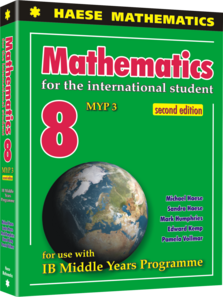
Discontinued Edition
Year Published: 2014
Page Count: 496
ISBN: 978-1-921972-47-8 (9781921972478)
Online ISBN: 978-1-921972-48-5 (9781921972485)
| 1 | NUMBER | 11 | |
| A | Natural numbers | 12 | |
| B | Integers | 13 | |
| C | Index notation | 15 | |
| D | Order of operations | 16 | |
| E | Absolute value | 20 | |
| F | Square numbers and square roots | 21 | |
| G | Primes and composites | 23 | |
| H | Highest common factor | 25 | |
| I | Lowest common multiple | 27 | |
| Review set 1A | 28 | ||
| Review set 1B | 29 | ||
| 2 | SETS AND VENN DIAGRAMS | 31 | |
| A | Sets | 32 | |
| B | Complement of a set | 34 | |
| C | Intersection and union | 36 | |
| D | Venn diagrams | 38 | |
| E | Problem solving with Venn diagrams | 44 | |
| Review set 2A | 46 | ||
| Review set 2B | 48 | ||
| 3 | REAL NUMBERS AND RATIO | 49 | |
| A | Fractions | 50 | |
| B | Operations with fractions | 53 | |
| C | Decimal numbers | 57 | |
| D | Operations with decimal numbers | 60 | |
| E | Rational numbers | 63 | |
| F | Irrational numbers | 66 | |
| G | Ratio | 68 | |
| Review set 3A | 73 | ||
| Review set 3B | 74 | ||
| 4 | ALGEBRAIC OPERATIONS | 75 | |
| A | Algebraic notation | 76 | |
| B | The language of mathematics | 78 | |
| C | Collecting like terms | 80 | |
| D | Generalising arithmetic | 81 | |
| E | Algebraic substitution | 83 | |
| F | Algebraic products | 86 | |
| G | Algebraic fractions | 87 | |
| Review set 4A | 89 | ||
| Review set 4B | 90 | ||
| 5 | PERCENTAGE | 91 | |
| A | Percentage | 92 | |
| B | Expressing one quantity as a percentage of another | 95 | |
| C | Finding a percentage of a quantity | 97 | |
| D | The unitary method in percentage | 98 | |
| E | Percentage increase and decrease | 100 | |
| F | Finding the original amount | 103 | |
| G | Simple interest | 104 | |
| Review set 5A | 106 | ||
| Review set 5B | 107 | ||
| 6 | INTERPRETING TABLES AND GRAPHS | 109 | |
| A | Interpreting tables | 110 | |
| B | Interpreting graphs | 115 | |
| C | Line graphs | 119 | |
| D | Travel graphs | 121 | |
| Review set 6A | 125 | ||
| Review set 6B | 127 | ||
| 7 | LAWS OF ALGEBRA | 129 | |
| A | Index laws | 130 | |
| B | Expansion laws | 133 | |
| C | The zero index law | 136 | |
| D | The negative index law | 137 | |
| E | The distributive law | 139 | |
| F | The product (a + b)(c + d) | 142 | |
| G | Perfect square expansion | 144 | |
| H | Difference of two squares | 145 | |
| Review set 7A | 146 | ||
| Review set 7B | 147 | ||
| 8 | EQUATIONS | 149 | |
| A | Solutions of an equation | 150 | |
| B | Linear equations | 151 | |
| C | Maintaining balance | 152 | |
| D | Inverse operations | 154 | |
| E | Algebraic flowcharts | 156 | |
| F | Solving equations | 157 | |
| G | Equations with a repeated unknown | 161 | |
| Review set 8A | 165 | ||
| Review set 8B | 166 | ||
| 9 | THE GEOMETRY OF POLYGONS | 167 | |
| A | Review of geometrical facts | 168 | |
| B | Triangles | 173 | |
| C | Isosceles triangles | 177 | |
| D | Quadrilaterals | 180 | |
| E | Angles of an n-sided polygon | 185 | |
| Review set 9A | 187 | ||
| Review set 9B | 189 | ||
| 10 | RADICALS AND PYTHAGORAS | 191 | |
| A | Square roots | 192 | |
| B | Solving x² = k | 195 | |
| C | Pythagoras' theorem | 197 | |
| D | The converse of Pythagoras' theorem | 202 | |
| E | Problem solving using Pythagoras | 204 | |
| F | 3-dimensional problems | 207 | |
| G | Cube roots | 209 | |
| Review set 10A | 211 | ||
| Review set 10B | 212 | ||
| 11 | LENGTH AND AREA | 213 | |
| A | Length | 214 | |
| B | Perimeter | 216 | |
| C | Circumference | 218 | |
| D | Area | 223 | |
| E | Area formulae | 224 | |
| F | Areas of circles and ellipses | 228 | |
| G | Areas of composite figures | 230 | |
| Review set 11A | 234 | ||
| Review set 11B | 235 | ||
| 12 | ALGEBRA: PATTERNS AND FORMULAE | 237 | |
| A | Geometric patterns | 238 | |
| B | Number crunching machines | 241 | |
| C | Substituting into formulae | 244 | |
| D | Using patterns | 246 | |
| E | Practical problems | 249 | |
| F | Number sequences | 251 | |
| Review set 12A | 252 | ||
| Review set 12B | 253 | ||
| 13 | FURTHER MEASUREMENT | 255 | |
| A | Surface area | 256 | |
| B | Volume | 261 | |
| C | Capacity | 269 | |
| Review set 13A | 272 | ||
| Review set 13B | 273 | ||
| 14 | COORDINATE GEOMETRY | 275 | |
| A | The Cartesian plane | 277 | |
| B | Linear relationships | 279 | |
| C | Gradient | 282 | |
| D | Axes intercepts | 287 | |
| E | The equation of a line | 288 | |
| F | Graphing lines from equations | 290 | |
| G | Vertical and horizontal lines | 294 | |
| H | Finding equations from graphs | 295 | |
| Review set 14A | 296 | ||
| Review set 14B | 297 | ||
| 15 | SIMULTANEOUS EQUATIONS | 299 | |
| A | Trial and error solution | 301 | |
| B | Graphical solution | 302 | |
| C | Solution by equating values of y | 303 | |
| D | Solution by substitution | 304 | |
| E | Solution by elimination | 305 | |
| F | Problem solving with simultaneous equations | 308 | |
| Review set 15A | 311 | ||
| Review set 15B | 312 | ||
| 16 | PROBABILITY | 313 | |
| A | Probability | 314 | |
| B | Sample space | 316 | |
| C | Theoretical probability | 318 | |
| D | Using 2-dimensional grids | 321 | |
| E | Compound events | 322 | |
| F | Experimental probability | 326 | |
| G | Probabilities from tabled data | 331 | |
| H | Expectation | 334 | |
| Review set 16A | 335 | ||
| Review set 16B | 336 | ||
| 17 | PROBLEM SOLVING | 339 | |
| A | Writing problems as equations | 340 | |
| B | Problem solving with algebra | 341 | |
| C | Problem solving by search | 344 | |
| D | Problem solving by working backwards | 346 | |
| E | Miscellaneous problems | 348 | |
| Review set 17A | 353 | ||
| Review set 17B | 354 | ||
| 18 | SIMILARITY AND CONGRUENCE | 357 | |
| A | Enlargements and reductions | 358 | |
| B | Similar figures | 360 | |
| C | Similar triangles | 364 | |
| D | Problem solving | 367 | |
| E | Congruent figures | 371 | |
| F | Congruent triangles | 373 | |
| G | Proof using congruence | 378 | |
| Review set 18A | 379 | ||
| Review set 18B | 381 | ||
| 19 | ALGEBRAIC FACTORISATION | 383 | |
| A | Common factors | 384 | |
| B | Factorising with common factors | 386 | |
| C | Difference of two squares factorising | 389 | |
| D | Perfect square factorisation | 391 | |
| E | Factorising quadratic trinomials | 393 | |
| F | Miscellaneous factorisation | 395 | |
| Review set 19A | 396 | ||
| Review set 19B | 397 | ||
| 20 | STATISTICS | 399 | |
| A | Categorical data | 400 | |
| B | Numerical data | 403 | |
| C | Grouped data | 405 | |
| D | Measuring the centre and spread | 409 | |
| E | Comparing numerical data | 416 | |
| F | Data collection | 418 | |
| Review set 20A | 421 | ||
| Review set 20B | 423 | ||
| 21 | QUADRATIC EQUATIONS | 425 | |
| A | Quadratic equations | 426 | |
| B | The Null Factor law | 427 | |
| C | Solving quadratic equations | 428 | |
| D | Problem solving with quadratic equations | 432 | |
| Review set 21A | 436 | ||
| Review set 21B | 437 | ||
| 22 | TRIGONOMETRY | 439 | |
| A | Scale diagrams in geometry | 441 | |
| B | Labelling right angled triangles | 442 | |
| C | The trigonometric ratios | 443 | |
| D | Finding side lengths | 447 | |
| E | Finding angles | 449 | |
| F | Problem solving with trigonometry | 451 | |
| Review set 22A | 454 | ||
| Review set 22B | 455 | ||
| 23 | INTRODUCTION TO NETWORKS | 457 | |
| A | Network diagrams | ONLINE | |
| B | Constructing networks | ONLINE | |
| C | Topologically equivalent networks | ONLINE | |
| D | Precedence networks | ONLINE | |
| E | Counting pathways | ONLINE | |
| Review set 23A | ONLINE | ||
| Review set 23B | ONLINE | ||
| ANSWERS | 458 | ||
| INDEX | 495 | ||






This book is available on electronic devices through our Snowflake learning platform. This book includes 15 months of Snowflake access, featuring a complete electronic copy of the textbook.
Where relevant, Snowflake features include interactive geometry, graphing, and statistics software, demonstrations, games, spreadsheets, and a range of printable worksheets, tables, and diagrams. Teachers are provided with a quick and easy way to demonstrate concepts, and students can discover for themselves and re-visit when necessary.

This book offers SELF TUTOR for every worked example. On the electronic copy of the textbook, access SELF TUTOR by clicking anywhere on a worked example to hear a step-by-step explanation by a teacher. This is ideal for catch-up and revision, or for motivated students who want to do some independent study outside school hours.

The International Baccalaureate Middle Years Programme focuses teaching and learning through six Global Contexts:
|
|
|
|
|
|
There are 6 projects included in this book, one for each of the Global Contexts. Each project is divided into factual, conceptual, and debatable questions to help guide the unit of work.
Projects are accompanied by a general descriptor and a task-specific descriptor for each of the relevant assessment criteria, to help teachers assess the unit of work.
The Global Contexts are intended as a focus for developing connections between different subject areas in the curriculum, and to promote an understanding of the interrelatedness of different branches of knowledge and the coherence of knowledge as a whole.
Graphics calculator instructions for Casio fx-9860G Plus, Casio fx-CG20, TI-84 Plus, and TI-nspire are included with this textbook. The textbook will either have comprehensive instructions at the start of the book, specific instructions available from icons located throughout, or both. The extensive use of graphics calculators and computer packages throughout the book enables students to realise the importance, application, and appropriate use of technology.