

About the Book
Year Published: 2011
Page Count: 423
ISBN: 978-1-921972-01-0 (9781921972010)
Online ISBN: 978-1-921972-86-7 (9781921972867)

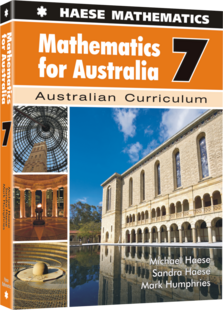
Discontinued Edition - digital subscriptions remain available
Year Published: 2011
Page Count: 423
ISBN: 978-1-921972-01-0 (9781921972010)
Online ISBN: 978-1-921972-86-7 (9781921972867)
| 1 | WHOLE NUMBERS | 9 | |
| A | The number system | 11 | |
| B | Number strategies | 13 | |
| C | Rounding numbers | 16 | |
| D | Estimation | 17 | |
| E | Operating with numbers | 19 | |
| F | Index notation | 24 | |
| G | Square numbers | 26 | |
| H | Order of operations | 27 | |
| Review set 1 | 31 | ||
| Practice test 1A: Multiple choice | 32 | ||
| Practice test 1B: Short response | 33 | ||
| Practice test 1C: Extended response | 33 | ||
| 2 | ANGLES, LINES, AND PARALLELISM | 35 | |
| A | Points and lines | 36 | |
| B | Measuring and classifying angles | 39 | |
| C | Angle properties | 42 | |
| D | Angle pairs | 46 | |
| E | Parallel lines | 49 | |
| F | Geometric construction | 54 | |
| Review set 2 | 58 | ||
| Practice test 2A: Multiple choice | CD | ||
| Practice test 2B: Short response | 60 | ||
| Practice test 2C: Extended response | 61 | ||
| 3 | PROPERTIES OF NUMBERS | 63 | |
| A | Divisibility tests | 64 | |
| B | Factors of natural numbers | 67 | |
| C | Prime and composite numbers | 69 | |
| D | Highest common factor | 72 | |
| E | Multiples of natural numbers | 74 | |
| F | Square roots of whole numbers | 76 | |
| Review set 3 | 78 | ||
| Practice test 3A: Multiple choice | CD | ||
| Practice test 3B: Short response | 79 | ||
| Practice test 3C: Extended response | 79 | ||
| 4 | POSITIVE AND NEGATIVE NUMBERS | 81 | |
| A | Opposites | 82 | |
| B | The number line | 85 | |
| C | Adding and subtracting negatives | 89 | |
| D | Multiplying negative numbers | 93 | |
| E | Dividing negative numbers | 95 | |
| F | Combined operations | 96 | |
| G | Using your calculator | 97 | |
| Review set 4 | 98 | ||
| Practice test 4A: Multiple choice | 99 | ||
| Practice test 4B: Short response | 100 | ||
| Practice test 4C: Extended response | 101 | ||
| 5 | FRACTIONS | 103 | |
| A | Common fractions | 105 | |
| B | Fractions as division | 106 | |
| C | Proper and improper fractions | 109 | |
| D | Placing fractions on a number line | 110 | |
| E | Equal fractions and simplifying | 111 | |
| F | Comparing fractions | 116 | |
| G | Adding and subtracting fractions | 117 | |
| H | Multiplying fractions | 119 | |
| I | Reciprocals | 121 | |
| J | Dividing fractions | 121 | |
| K | Evaluating fractions using a calculator | 123 | |
| L | Problem solving | 124 | |
| Review set 5 | 126 | ||
| Practice test 5A: Multiple choice | CD | ||
| Practice test 5B: Short response | 127 | ||
| Practice test 5C: Extended response | 127 | ||
| 6 | DECIMAL NUMBERS | 129 | |
| A | Place value | 130 | |
| B | Converting decimals to fractions | 132 | |
| C | Rounding decimal numbers | 133 | |
| D | Ordering decimal numbers | 134 | |
| E | Adding and subtracting decimal numbers | 137 | |
| F | Multiplying by powers of 10 | 140 | |
| G | Dividing by powers of 10 | 141 | |
| H | Multiplying decimal numbers | 142 | |
| I | Dividing decimal numbers | 145 | |
| Review set 6 | 147 | ||
| Practice test 6A: Multiple choice | 148 | ||
| Practice test 6B: Short response | 149 | ||
| Practice test 6C: Extended response | 149 | ||
| 7 | ALGEBRA: EXPRESSIONS AND FORMULAE | 151 | |
| A | Building expressions | 152 | |
| B | Key words in algebra | 158 | |
| C | Simplifying expressions | 159 | |
| D | Algebraic products | 162 | |
| E | Evaluating algebraic expressions | 164 | |
| F | Formulae | 166 | |
| G | Practical problems using formulae | 168 | |
| Review set 7 | 171 | ||
| Practice test 7A: Multiple choice | 172 | ||
| Practice test 7B: Short response | 173 | ||
| Practice test 7C: Extended response | 173 | ||
| 8 | PERCENTAGE | 175 | |
| A | Understanding percentages | 176 | |
| B | Interchanging number forms | 178 | |
| C | One quantity as a percentage of another | 182 | |
| D | Finding a percentage of a quantity | 185 | |
| Review set 8 | 187 | ||
| Practice test 8A: Multiple choice | 188 | ||
| Practice test 8B: Short response | 189 | ||
| Practice test 8C: Extended response | 190 | ||
| 9 | EQUATIONS | 191 | |
| A | Equations | 192 | |
| B | Solving simple equations | 193 | |
| C | Maintaining balance | 195 | |
| D | Inverse operations | 199 | |
| E | Algebraic flowcharts | 202 | |
| F | Solving equations | 203 | |
| G | Equations with a repeated variable | 206 | |
| H | Writing equations | 207 | |
| I | Problem solving | 207 | |
| Review set 9 | 209 | ||
| Practice test 9A: Multiple choice | CD | ||
| Practice test 9B: Short response | 210 | ||
| Practice test 9C: Extended response | 211 | ||
| 10 | POLYGONS | 213 | |
| A | Polygons | 214 | |
| B | Triangles | 218 | |
| C | Angles of a triangle | 219 | |
| D | Isosceles triangles | 224 | |
| E | Quadrilaterals | 226 | |
| F | Angles of a quadrilateral | 230 | |
| Review set 10 | 232 | ||
| Practice test 10A: Multiple choice | CD | ||
| Practice test 10B: Short response | 234 | ||
| Practice test 10C: Extended response | 235 | ||
| 11 | COORDINATES | 237 | |
| A | Map references | 239 | |
| B | Number grids | 241 | |
| C | Positive and negative coordinates | 244 | |
| D | Plotting points from a table of values | 247 | |
| Review set 11 | 249 | ||
| Practice test 11A: Multiple choice | CD | ||
| Practice test 11B: Short response | 250 | ||
| Practice test 11C: Extended response | 251 | ||
| 12 | MEASUREMENT | 253 | |
| A | Length | 254 | |
| B | Perimeter | 256 | |
| C | Area | 260 | |
| D | The area of a rectangle | 263 | |
| E | Other areas | 265 | |
| F | Volume | 269 | |
| Review set 12 | 272 | ||
| Practice test 12A: Multiple choice | 273 | ||
| Practice test 12B: Short response | 274 | ||
| Practice test 12C: Extended response | 275 | ||
| 13 | RATIO AND RATES | 277 | |
| A | Ratio | 278 | |
| B | Writing ratios as fractions | 280 | |
| C | Equal ratios | 281 | |
| D | Problem solving using ratios | 284 | |
| E | Rates | 289 | |
| F | Comparing prices | 290 | |
| Review set 13 | 292 | ||
| Practice test 13A: Multiple choice | CD | ||
| Practice test 13B: Short response | 293 | ||
| Practice test 13C: Extended response | 294 | ||
| 14 | LINE GRAPHS | 295 | |
| A | Properties of line graphs | 296 | |
| B | Estimating from line graphs | 298 | |
| C | Travel graphs | 304 | |
| Review set 14 | 306 | ||
| Practice test 14A: Multiple choice | CD | ||
| Practice test 14B: Short response | 308 | ||
| Practice test 14C: Extended response | 309 | ||
| 15 | PROBABILITY | 311 | |
| A | Describing probability | 312 | |
| B | Assigning numbers to probabilities | 314 | |
| C | Sample space | 316 | |
| D | Theoretical probability | 317 | |
| Review set 15 | 323 | ||
| Practice test 15A: Multiple choice | CD | ||
| Practice test 15B: Short response | 324 | ||
| Practice test 15C: Extended response | 325 | ||
| 16 | STATISTICS | 327 | |
| A | Data collection | 329 | |
| B | Categorical data | 330 | |
| C | Numerical data | 336 | |
| D | Measuring the centre and spread | 341 | |
| Review set 16 | 347 | ||
| Practice test 16A: Multiple choice | CD | ||
| Practice test 16B: Short response | 349 | ||
| Practice test 16C: Extended response | 350 | ||
| 17 | TRANSFORMATIONS | 351 | |
| A | Translations | 352 | |
| B | Reflections and line symmetry | 355 | |
| C | Rotations and rotational symmetry | 359 | |
| D | Combinations of transformations | 365 | |
| Review set 17 | 368 | ||
| Practice test 17A: Multiple choice | CD | ||
| Practice test 17B: Short response | 369 | ||
| Practice test 17C: Extended response | 371 | ||
| 18 | SOLIDS | 373 | |
| A | Drawing rectangular solids | 374 | |
| B | Views of solids | 378 | |
| Review set 18 | 382 | ||
| Practice test 18A: Multiple choice | CD | ||
| Practice test 18B: Short response | 383 | ||
| Practice test 18C: Extended response | 384 | ||
| ANSWERS | 385 | ||
| INDEX | 422 | ||




This book offers SELF TUTOR for every worked example. On the electronic copy of the textbook, access SELF TUTOR by clicking anywhere on a worked example to hear a step-by-step explanation by a teacher. This is ideal for catch-up and revision, or for motivated students who want to do some independent study outside school hours.

Early prints of this textbook came with a Student CD. Recent prints of this book include 15 months of access for electronic devices through our Snowflake learning platform.
Where relevant, Snowflake or the Student CD include a complete electronic copy of the book with interactive geometry, graphing, and statistics software, demonstrations, games, spreadsheets, and a range of printable worksheets, tables, and diagrams. Teachers are provided with a quick and easy way to demonstrate concepts, and students can discover for themselves and re-visit when necessary.