

About the Book
Year Published: 2013
Page Count: 480
ISBN: 978-1-921972-04-1 (9781921972041)
Online ISBN: 978-1-921972-89-8 (9781921972898)

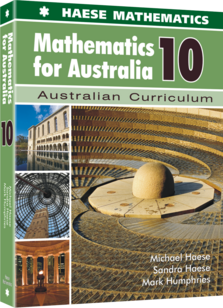
Discontinued Edition - digital subscriptions remain available
Year Published: 2013
Page Count: 480
ISBN: 978-1-921972-04-1 (9781921972041)
Online ISBN: 978-1-921972-89-8 (9781921972898)
| GRAPHICS CALCULATOR INSTRUCTIONS | 8 | ||
| Casio fx-9860G PLUS | CD | ||
| Texas Instruments TI-84 Plus | CD | ||
| Texas Instruments TI-nspire | CD | ||
| 1 | OPERATIONS WITH NUMBERS | 9 | |
| A | Operations with integers | 10 | |
| B | Order of operations | 12 | |
| C | Indices | 14 | |
| D | Scientific notation (standard form) | 18 | |
| Review set 1 | 22 | ||
| Practice test 1A - Multiple choice | CD | ||
| Practice test 1B - Short response | 23 | ||
| Practice test 1C - Extended response | 23 | ||
| 2 | ALGEBRAIC EXPANSION AND FACTORISATION | 25 | |
| A | Expansion laws | 26 | |
| B | Further expansion | 31 | |
| C | The binomial expansion | 32 | |
| D | Revision of factorisation | 34 | |
| E | Factorising expressions with four terms | 38 | |
| F | Factorising quadratic trinomials | 39 | |
| G | Miscellaneous factorisation | 40 | |
| Review set 2 | 41 | ||
| Practice test 2A - Multiple choice | CD | ||
| Practice test 2B - Short response | 42 | ||
| Practice test 2C - Extended response | 43 | ||
| 3 | RADICALS | 45 | |
| A | Radicals and surds | 46 | |
| B | Simplifying radicals | 48 | |
| C | Adding and subtracting radicals | 51 | |
| D | Multiplications involving radicals | 52 | |
| Review set 3 | 55 | ||
| Practice test 3A - Multiple choice | CD | ||
| Practice test 3B - Short response | 56 | ||
| Practice test 3C - Extended response | 56 | ||
| 4 | ALGEBRAIC FRACTIONS | 57 | |
| A | Evaluating algebraic fractions | 58 | |
| B | Simplifying algebraic fractions | 59 | |
| C | Multiplying and dividing algebraic fractions | 64 | |
| D | Adding and subtracting algebraic fractions | 67 | |
| Review set 4 | 70 | ||
| Practice test 4A - Multiple choice | CD | ||
| Practice test 4B - Short response | 71 | ||
| Practice test 4C - Extended response | 72 | ||
| 5 | LINEAR EQUATIONS AND INEQUALITIES | 73 | |
| A | Solving linear equations | 74 | |
| B | Equations with fractions | 78 | |
| C | Linear equation problems | 80 | |
| D | Linear inequalities | 83 | |
| E | Solving linear inequalities | 85 | |
| F | Linear inequality problems | 89 | |
| Review set 5 | 90 | ||
| Practice test 5A - Multiple choice | CD | ||
| Practice test 5B - Short response | 91 | ||
| Practice test 5C - Extended response | 91 | ||
| 6 | PYTHAGORAS' THEOREM | 93 | |
| A | Pythagoras' theorem | 94 | |
| B | The converse of Pythagoras' theorem | 99 | |
| C | Pythagorean triples | 101 | |
| D | Problem solving using Pythagoras | 103 | |
| E | Circle problems | 107 | |
| Review set 6 | 111 | ||
| Practice test 6A - Multiple choice | CD | ||
| Practice test 6B - Short response | 112 | ||
| Practice test 6C - Extended response | 113 | ||
| 7 | MEASUREMENT | 115 | |
| A | Length and perimeter | 116 | |
| B | Area | 120 | |
| C | Surface area | 125 | |
| D | Volume | 132 | |
| E | Capacity | 139 | |
| Review set 7 | 142 | ||
| Practice test 7A - Multiple choice | CD | ||
| Practice test 7B - Short response | 143 | ||
| Practice test 7C - Extended response | 144 | ||
| 8 | FORMULAE | 147 | |
| A | Formula construction | 148 | |
| B | Formula substitution | 152 | |
| C | Formula rearrangement | 154 | |
| D | Rearrangement and substitution | 158 | |
| E | Formulae by induction | 161 | |
| Review set 8 | 163 | ||
| Practice test 8A - Multiple choice | CD | ||
| Practice test 8B - Short response | 164 | ||
| Practice test 8C - Extended response | 165 | ||
| 9 | CONGRUENCE AND SIMILARITY | 167 | |
| A | Congruence of figures | 168 | |
| B | Congruent triangles | 169 | |
| C | Proof using congruence | 173 | |
| D | Similarity | 176 | |
| E | Similar triangles | 178 | |
| F | Areas and volumes | 183 | |
| Review set 9 | 186 | ||
| Practice test 9A - Multiple choice | CD | ||
| Practice test 9B - Short response | 188 | ||
| Practice test 9C - Extended response | 189 | ||
| 10 | QUADRATIC EQUATIONS | 191 | |
| A | Equations of the form x² = k | 192 | |
| B | The Null Factor law | 194 | |
| C | Solution by factorisation | 195 | |
| D | Completing the square | 197 | |
| E | The quadratic formula | 199 | |
| F | Problem solving | 201 | |
| Review set 10 | 205 | ||
| Practice test 10A - Multiple choice | 206 | ||
| Practice test 10B - Short response | 207 | ||
| Practice test 10C - Extended response | 208 | ||
| 11 | COORDINATE GEOMETRY | 209 | |
| A | Distance between two points | 211 | |
| B | Midpoints | 214 | |
| C | Gradient | 216 | |
| D | Parallel and perpendicular lines | 219 | |
| E | The equation of a line | 223 | |
| F | Graphing lines from equations | 226 | |
| G | Finding the equation of a line | 228 | |
| Review set 11 | 231 | ||
| Practice test 11A - Multiple choice | CD | ||
| Practice test 11B - Short response | 232 | ||
| Practice test 11C - Extended response | 233 | ||
| 12 | TRIGONOMETRY | 235 | |
| A | Labelling right angled triangles | 236 | |
| B | The trigonometric ratios | 237 | |
| C | Finding side lengths | 240 | |
| D | Finding angles | 242 | |
| E | Problem solving with trigonometry | 244 | |
| F | True bearings | 248 | |
| Review set 12 | 250 | ||
| Practice test 12A - Multiple choice | CD | ||
| Practice test 12B - Short response | 252 | ||
| Practice test 12C - Extended response | 253 | ||
| 13 | STATISTICS | 255 | |
| A | Discrete data | 256 | |
| B | Continuous data | 259 | |
| C | Measuring the centre | 261 | |
| D | Cumulative data | 268 | |
| E | Measuring the spread | 270 | |
| F | Box plots | 274 | |
| G | Evaluating reports | 280 | |
| Review set 13 | 283 | ||
| Practice test 13A - Multiple choice | CD | ||
| Practice test 13B - Short response | 285 | ||
| Practice test 13C - Extended response | 287 | ||
| 14 | FINANCIAL MATHEMATICS | 289 | |
| A | Business calculations | 290 | |
| B | Appreciation and depreciation | 295 | |
| C | Simple interest | 297 | |
| D | Compound interest | 301 | |
| Review set 14 | 305 | ||
| Practice test 14A - Multiple choice | CD | ||
| Practice test 14B - Short response | 305 | ||
| Practice test 14C - Extended response | 306 | ||
| 15 | SIMULTANEOUS EQUATIONS | 307 | |
| A | Graphical solution | 308 | |
| B | Solution by substitution | 311 | |
| C | Solution by elimination | 312 | |
| D | Problem solving | 314 | |
| Review set 15 | 318 | ||
| Practice test 15A - Multiple choice | CD | ||
| Practice test 15B - Short response | 319 | ||
| Practice test 15C - Extended response | 320 | ||
| 16 | PROBABILITY | 321 | |
| A | Theoretical probability | 323 | |
| B | Compound events | 327 | |
| C | Expectation | 333 | |
| D | Conditional probability | 335 | |
| Review set 16 | 338 | ||
| Practice test 16A - Multiple choice | CD | ||
| Practice test 16B - Short response | 340 | ||
| Practice test 16C - Extended response | 341 | ||
| 17 | RELATIONS AND FUNCTIONS | 343 | |
| A | Relations | 344 | |
| B | Functions | 347 | |
| C | Function notation | 348 | |
| D | Transforming y = f(x) | 351 | |
| Review set 17 | 360 | ||
| Practice test 17A - Multiple choice | CD | ||
| Practice test 17B - Short response | 362 | ||
| Practice test 17C - Extended response | 363 | ||
| 18 | QUADRATIC FUNCTIONS | 365 | |
| A | Quadratic functions | 366 | |
| B | Graphs of quadratic functions | 368 | |
| C | Axes intercepts | 375 | |
| D | Axis of symmetry | 379 | |
| E | Vertex | 381 | |
| F | Quadratic optimisation | 384 | |
| Review set 18 | 386 | ||
| Practice test 18A - Multiple choice | CD | ||
| Practice test 18B - Short response | 387 | ||
| Practice test 18C - Extended response | 388 | ||
| 19 | EXPONENTIAL FUNCTIONS | 389 | |
| A | Exponential functions | 390 | |
| B | Graphs of exponential functions | 391 | |
| C | Growth and decay | 395 | |
| Review set 19 | 399 | ||
| Practice test 19A - Multiple choice | CD | ||
| Practice test 19B - Short response | 400 | ||
| Practice test 19C - Extended response | 400 | ||
| 20 | CIRCLES AND ELLIPSES | 401 | |
| A | Circles | 402 | |
| B | Ellipses | 408 | |
| Review set 20 | 411 | ||
| Practice test 20A - Multiple choice | CD | ||
| Practice test 20B - Short response | 413 | ||
| Practice test 20C - Extended response | 413 | ||
| 21 | BIVARIATE STATISTICS | 415 | |
| A | Line graphs | 416 | |
| B | Scatter plots | 419 | |
| C | Correlation | 421 | |
| Review set 21 | 425 | ||
| Practice test 21A - Multiple choice | CD | ||
| Practice test 21B - Short response | 426 | ||
| Practice test 21C - Extended response | 428 | ||
| ANSWERS | 429 | ||
| INDEX | 479 | ||




This book offers SELF TUTOR for every worked example. On the electronic copy of the textbook, access SELF TUTOR by clicking anywhere on a worked example to hear a step-by-step explanation by a teacher. This is ideal for catch-up and revision, or for motivated students who want to do some independent study outside school hours.
Graphics calculator instructions for Casio fx-9860G Plus, TI-84 Plus, and TI-nspire are included with this textbook. The textbook will either have comprehensive instructions at the start of the book, specific instructions available from icons located throughout, or both. The extensive use of graphics calculators and computer packages throughout the book enables students to realise the importance, application, and appropriate use of technology.

Early prints of this textbook came with a Student CD. Recent prints of this book include 15 months of access for electronic devices through our Snowflake learning platform.
Where relevant, Snowflake or the Student CD include a complete electronic copy of the book with interactive geometry, graphing, and statistics software, demonstrations, games, spreadsheets, and a range of printable worksheets, tables, and diagrams. Teachers are provided with a quick and easy way to demonstrate concepts, and students can discover for themselves and re-visit when necessary.